
Post-Construction Exterior Coatings
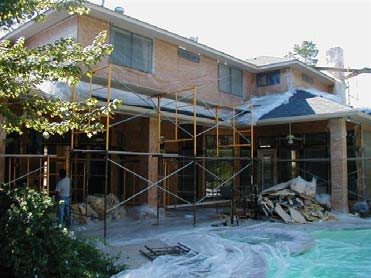
I’ve learned a lot repairing and replacing failed stucco systems this past decade. In my personal involvement with well over 2000 single family homes most of the hard lessons learned have come at the expense of others. Many millions of post construction dollars have been wasted in a trial and error process which is driven by product sales and not sound building science.
I once sat in a meeting with local managers of the nation’s largest homebuilder and listened with skepticism as we all in the room were assured by a salesman, who was backed by the world’s largest supplier of construction materials that their repair coatings and sealant details would cure all ills associated with the hundreds of failed stucco systems involved on the project. Since an overcoat of a different yet similar product had already been attempted on many of the troubled homes and the repair attempt had failed, I as well as others present questioned the “new and improved”
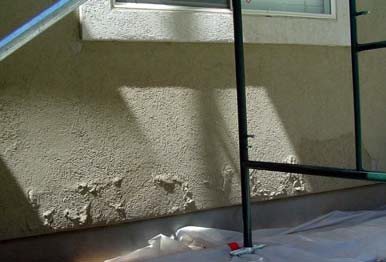
repair plan. All of us were assured that the proposed “state of the art” coatings were “breathable like ‘GORTEX’” and were “15 times more flexible than the materials previously used”. The new highly flexible materials would allow for the unpredictable movement of the poorly applied existing stucco system. Plus there was a “labor and material warranty” provided by a huge and established national company which was backed by an even bigger multi national parent company.
The sophisticated repair work went forward; however, after four million dollars and a year of tough Utah weather, nearly all of the repairs failed. Some of the most respected building scientists and stucco experts in the nation were involved with this project. The best products available on earth were used. Not to mention an extremely careful and thorough remedial contractor was involved as well. In the end there was no support from the material
supplier, who was also the designer of the repair system. This national builder as well as another builder who had spent fifteen million dollars in a similar repair by the same supplier were left “high and dry” because of some exclusion clause (written in ‘6 font’) in the warranty agreement. So what happened?
To answer this question we must first take a few steps backwards and examine recent changes in residential construction. These changes have led to greater differences in pressure from the inside of a home to the outside of a home. Negative pressure inside a home which can be caused by wind blowing against a given exterior wall assembly during a storm will be more concentrated at penetrations in the assembly. In other words, a stronger sucking action towards the inside is created because the forces are funneled to points of failure.
Currently a home is much more airtight than in the past. A home built in 1981 for example used to “breath” much better than a “modern” more energy efficient home of today. By “breath” I mean that air was exchanged more evenly and more freely from the inside of a home to the outside and vice versa. I use the year 1981 as an example because it was in 1982 that “Title 24” was introduced which promoted the movement towards energy efficiency in home building. We started seeing every type of insulation and sealants being introduced. Polyurethane expanding foam was commonly used to seal around windows, doors, and even where electrical wire passed through floor plate lines. Not too long after the energy craze, open bay wall framing in the west was replaced with plywood on all exterior walls because of an increase in the understanding of seismic requirements. The question of whether to use a visqueen vapor barrier on exterior walls went back and forth as well (Have we yet reached common ground on this “Catch 22” ?).
Thermal windows, or dual paned windows, soon became the norm in residential construction in the west. It became accepted practice to use caulking at all window edges where the window frame met the wall framing.
Then finally, vinyl windows replaced aluminum windows which allowed for less heat transfer and an even greater pressure differential between the inside and the outside of a home.
The introduction of another key player in our mystery is “Oriented Strand Board”.
Commonly known as O.S.B. plywood, this type of exterior sheathing has become almost exclusive in residential construction. The small chips of wood which are used to make this type of plywood are held together with organic adhesives which, in my observations, appear to be mold candy. While helping a friend put a
stone wainscot on his home in the Alaskan Bush, we stacked 15 sheets or so of mixed plywood against a tree outside. After only a month of being exposed to the Alaskan humidity, the O.S.B. plywood in the stack was covered with mold while the CDX plywood looked like new.
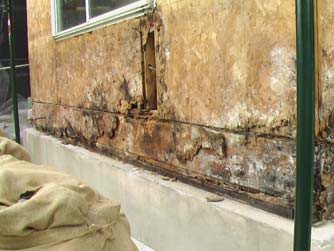
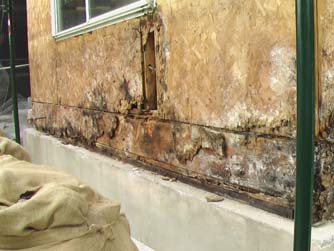
The extremely absorbent plywood mixed with walls which cannot “breath” has led to a phenomenon in modern residential wall construction that is completely unforgiving of even the minutest of moisture intrusion. I once spent 14 hours with one of the nation’s top sealant and coatings specialists, and the most sophisticated of testing equipment, to discover, finally, that the massive failure on a coated wall was caused by fractures in the elastic repair primers and stucco overcoat finishes. The defiant cracks in the repair coatings were so small it took a magnifying glass to see them. The powerful sucking action created at the minuscule tears in this “super coated” wall, due to negative pressure inside the home, was enough to let copious amounts of water into the wall cavity. Water, which now because of the “super coating”, could not easily escape. Mold needs three things to survive: a dark and warm environment, food, and water. The trapped water gives to the organic parasites the last ingredient they need to succeed – moisture.
Remember they already have plenty of food that’s chopped up in little bits and served with a “candy”
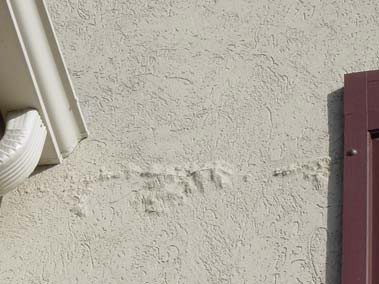
coating.
The application of any “super coating” leads to the opposite of a solution. We should be looking for solutions in the other direction. We need to find ways to make walls breath better, not worse. As long as there’s O.S.B . plywood involved and sealed thermal windows and doors, as well as caulking at every joint, placing a repair coating over an existing stucco system which has failed will result in the certain
and untimely death of a home. A “warranty”, even by the most giant of companies is no solution because it is too easy to blame failures of a repair coating on deficiencies in the original construction. Even if the coating manufacturer stays in business it’s imminent that the failure will be blamed on excessive movement caused by a weakness in the original substrate. It’s better to rely on sound building science than a warranty that only stands a chance if a given manufacturer is still selling enough product in your market.
Dennis McCoy is a lifelong builder And is owner of RAM Builders, Inc And RAM Exteriors, LLC. He has Operations in Texas and Utah.